
Beyond BTC: Splitting 388 TH/s Across a Multi-Coin Pool
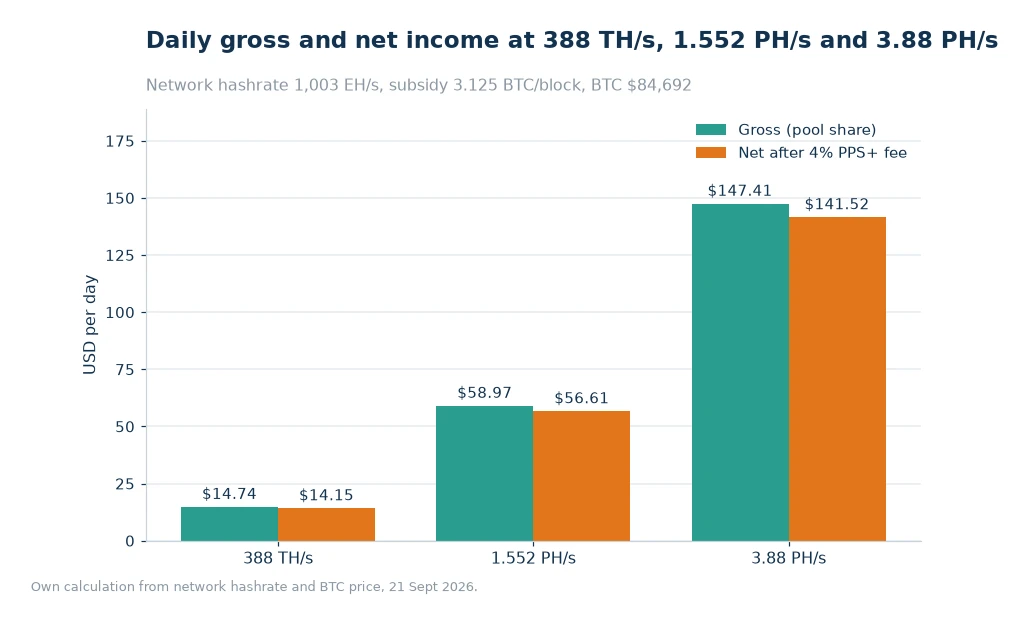
A machine does not care which coin it hashes. It cares about the algorithm, the power draw and whether the coin's price covers the electricity. A miner running 388 TH/s on Bitcoin earns about 0.00017406 BTC a day, or $14.74 gross at $84,692, and that number is fixed by network hashrate rather than by loyalty. The interesting question is whether part of that capacity belongs somewhere else.
Key takeaways
- 388 TH/s on Bitcoin produces 0.00017406 BTC a day, $14.15 net after the listed 4%.
- LTC and DOGE are mined together as merged mining, so one hash rate can earn two chains.
- Each coin has its own difficulty and price, so splitting hashrate changes both output and variance.
- Start with one alternative coin and one week of measured output before moving more capacity.
Why a single-coin miner starts looking around
The usual trigger is a spreadsheet that has stopped moving. Revenue per terahash on Bitcoin drifts down as the network grows, and the only lever left is cost. Some miners respond by buying newer hardware. Others look at what else the existing machine could point at, and discover that the pool supports more than twenty coins, several of them on algorithms their hardware already handles.
The second trigger is a price move in a smaller coin. A miner reads that KAS is up, or that Litecoin halved its issuance, and wonders whether the same watts would buy more there. That instinct is reasonable, but it has to survive two tests: does the hardware support the algorithm, and does the coin's network size make the output meaningful rather than a rounding error?
The third trigger is diversification for its own sake. A miner who is paid in one asset has a concentrated position by default. Being paid in three assets is a portfolio decision that happens to be executed by a pool, and it is worth making deliberately rather than by accident.
What merged mining changes about the arithmetic
Litecoin and Dogecoin can be mined at the same time. The machine solves one proof of work and the pool credits both chains, which is why merged mining appears in the product list rather than being treated as two separate operations. For a miner already committed to Scrypt hardware, that is the cheapest form of diversification available: the same watts, two income streams.
Bitcoin does not work that way. SHA-256 capacity earns BTC and nothing else, so a 388 TH/s Bitcoin rig is a single-asset position by construction. Diversifying that machine means diverting some of its time to another SHA-256 coin such as BCH, not stacking rewards on top of the same work.
Understanding which of those two situations you are in prevents most bad decisions. Merged mining adds a stream; switching algorithms replaces one. Confusing them leads miners to expect a free second income from hardware that cannot produce it.
Reading the coin menu without guessing
Each coin the pool supports has its own difficulty, block time, subsidy schedule and market price. None of those appear in the Bitcoin figures used here, so any claim about what a terahash earns on KAS or ETC has to come from current chain data rather than from a rule of thumb. The pool's own profitability ranking exists precisely because that arithmetic changes weekly.
Use the ranking as a shortlist, not an answer. It compares models at current prices and difficulty, which is useful for spotting a coin whose revenue per watt has moved, and less useful for deciding whether you personally want to hold that coin. Output is only half the question; what you do with the coins afterward is the other half.
Liquidity deserves a mention. A coin with a thin market is harder to convert when the power bill arrives, and the Miner Profitability Ranking will not tell you that. The multi-currency wallet and Auto Conversion exist to shorten that step, but they cannot create depth that the market does not have.
| Coin | How it is mined | Case for it | What to check first |
|---|---|---|---|
| BTC | SHA-256, single chain | Deepest market, easiest conversion | 0.00017406 BTC a day at 388 TH/s |
| LTC / DOGE | merged mining on Scrypt | Two rewards from one proof of work | Scrypt hardware, not SHA-256 |
| KAS | kHeavyHash, separate algorithm | Different hardware, different cycle | ASIC support and market depth |
| BCH | SHA-256, single chain | Same machines as BTC | Relative difficulty and price |
Worked example
Keep the Bitcoin line as the yardstick, then compare any alternative against it.
- Network fraction: 388 ÷ 1,003,107,267 = 3.86798e-7.
- Times the 450 BTC issued daily: 3.86798e-7 × 450 = 0.00017406 BTC.
- In dollars: 0.00017406 × 84,692 = $14.74.
- Net of the 4% listed on that component: 14.74 × 0.96 = $14.15.
- Four times the hashrate, 1.552 PH/s: 0.00069631 BTC, $58.97 gross, $56.61 net.
- Ten times, 3.88 PH/s: 0.00174078 BTC, $147.41 gross, $141.52 net.
- A 25% diversion of 388 TH/s leaves 291 TH/s on BTC, worth 0.00013055 BTC a day, and puts 97 TH/s on the alternative.
Running a mixed fleet without extra chaos
Mixed fleets fail at the seams. A worker pointed at the wrong coin, a wallet address from the right coin but the wrong network, a firmware profile left over from a test last month. The fix is a naming convention that includes the coin, so btc-hall-01 and kas-shed-02 can never be confused in a list sorted alphabetically.
Give each coin its own account or at least its own clearly labeled sub-account. Settlement schedules differ, and a combined balance hides which stream produced what. When a coin's difficulty moves sharply, you want to see that coin's series alone rather than a blended total that tells you nothing.
Cap the experiment. Move one machine or one quarter of the capacity, run it for a full difficulty window, and compare the BTC-equivalent value of the output after conversion costs. If it does not beat the Bitcoin line by enough to justify the extra bookkeeping, move it back. The cost of the test is a few weeks of slightly lower output, which is cheap compared with a year of the wrong allocation.
Fees do not disappear when the coin changes
The listed rates in this article are the Bitcoin ones: 4% on the PPS-settled block reward and 2% on the transaction-fee component for PPS+, or 2% on both combined under PPLNS. Other coins have their own schedules, and reading one coin's rate as if it applied to another is a common error when a miner diversifies for the first time.
Check the fee line for each coin before committing capacity, and note that merged mining credits two chains under one set of shares. The second chain is a bonus stream attached to the same work, not a second fee event, which is part of why the Scrypt route is attractive to miners who already own the hardware.
ViaBTC Bitcoin Mining is the account view where all of this sits together: workers, coins, settlement mode and balance. For a miner adding a second coin, that single view is the difference between a controlled experiment and a second business to run.
Frequently asked questions
Can I mine Litecoin and Dogecoin at the same time?
Yes. LTC and DOGE use merged mining, so one Scrypt hash rate earns rewards on both chains without doubling the electricity or the work.
Can a Bitcoin ASIC mine KAS?
No. KAS uses a different algorithm, so it needs its own hardware; a SHA-256 machine can only move between SHA-256 coins such as BTC and BCH.
How much should I move to a second coin?
Start with one unit or roughly a quarter of capacity for a full difficulty window, then compare BTC-equivalent output after conversion costs before moving more.
Make the second coin earn its place
Diversification is only worth the complexity if the second stream beats the first after every cost, including the time spent reconciling two statements. Write the comparison down, give it a deadline, and be willing to reverse it. A fleet that can change its mind cheaply is more robust than one that picked a coin once and defended the choice for a year.
The Statistics page gives the pool and network figures to check the experiment against. If the alternative coin's share of your output is shrinking while its difficulty climbs, the market is telling you something the price chart has not yet shown.
Sources: ViaBTC coin list, miner ranking and statistics pages for supported algorithms and settlement details[1]. Bitcoin inputs read 21 Sept 2026: 1,003 EH/s of network hashrate, 132.76 T difficulty, 3.125 BTC subsidy over 144 daily blocks, $84,692 per BTC. Published 24 Oct 2026; no output estimate is given here for the alternative coins.