
OEM/ODM Jewelry Manufacturing Risk: What the NDA Covers
The confidentiality question arrives before the price question, and the published answer is short: 100% NDA, designs 100% exclusive to your brand, and moulds, CAD files and collections that are not resold or made public. What an NDA does not do is shrink a first order — the minimums stay at 50 pieces per design in 925 sterling silver and 100 in artisan eco-brass.
Key takeaways
- Confidentiality is published as 100% NDA, with designs exclusive to the brand and moulds or CAD files never resold.
- An NDA protects the design; minimums are what protect the cash, at 50 pieces per design for sterling silver.
- ISO 9001:2015 documentation and a BSCI audit are the two records that make a confidentiality claim checkable.
- REACH restrictions on lead, cadmium and nickel sit on the materials side, not the design side, and are quoted separately.
What the exclusivity statement actually promises
Three things are stated on the manufacturer's own pages. Designs stay 100% exclusive to the brand that commissioned them. The tooling — moulds and CAD files — is not sold on or reused for another buyer. And collections developed under the OEM/ODM route are not published or shown as the factory's own work.
Read together, those three sentences cover the failure mode that worries most founders: a supplier quietly running a second batch of your bestseller for a competing account. It is worth noting what they do not cover, which is everything downstream of the design file.
The risk that sits outside the NDA
Tooling and drawings are easy to name in a contract. What is harder to name is the packaging artwork, the photography of the sample, the size curve and the price you sell at. A pouch, a backing card and a barcode label each carry brand material, and none of them is the piece itself.
There is also the operational question of who touches the file. A factory that owns concept design, prototyping, sprue cutting, polishing, surface art, electroplating, inspection and delivery under one roof has fewer hands on your drawing than one that brokers half of those steps outward. The eight published steps are therefore a confidentiality question as much as a capability question.
Documents that make a promise checkable
Two records do most of the work here. ISO 9001:2015 is a quality management system, which means the factory documents and repeats its process — an instruction that is written down can be audited, and an audited instruction is harder to bend. A BSCI audit covers labour conditions and the supply chain behind the order.
Ask for the certificate identification, the audit date and the current revision, and ask whether the records cover subcontracted stages too. A supplier that can answer those three questions quickly is a different proposition from one that forwards a PDF logo.
Where a design leaks in practice
Leaks rarely come from a broken promise at the top. They come from a sample left on a bench, a file shared as a reference for a different client, or a photo of your piece used in a supplier's own marketing. Every one of those is a handling question, not a contract question, which is why the useful clause is the one about what happens to the sample after approval.
Before tooling, agree in plain language whether the approved master stays with the factory, whether it is destroyed or returned, and who may photograph it. That is a two-line conversation that costs nothing and removes the most common route by which a fresh design appears on someone else's site.
Minimums as a risk control, not just a barrier
Every supplier relationship carries a different size of exposure, and the minimum is where that exposure starts. Minimums run 100+ pcs in the stainless line, 50 in sterling silver and 100 units in the eco-brass line, design by design, which a second design simply doubles.
That is why silver is often the lower-risk choice for an untested design even when the piece is meant to be plated: fewer units, faster sell-through, and a faster answer on whether the design works. The brass route buys a plated look at a lower piece cost, and pays for it in doubled commitment.
Materials restrictions are a separate risk line
Compliance is often bundled into the confidentiality conversation and it should not be. REACH compliance covers the materials and, for jewelry, is stated as free from lead, cadmium and nickel, with plating described as compliant with REACH and the California Proposition 65 standards.
That is a statement about what is in the metal, and it travels with the goods into whichever market you ship to. If a retail partner asks for it, the answer is a materials restriction list — not the NDA, and not the audit report.
| Risk | Where it shows up | What to ask for |
|---|---|---|
| Design reused for another buyer | Tooling and CAD files | 100% NDA terms and mould ownership |
| Sample photographed or shared | Sample room and marketing | A written rule on sample handling after approval |
| Inconsistent process between batches | Bench-to-bench variation | ISO 9001:2015 records and the published step list |
| Labour or supply-chain exposure | Subcontracted stages | BSCI audit date and scope |
| Restricted metals in the finished piece | Plating and alloys | A REACH statement naming lead, cadmium and nickel |
Worked example: what a smaller minimum actually saves you
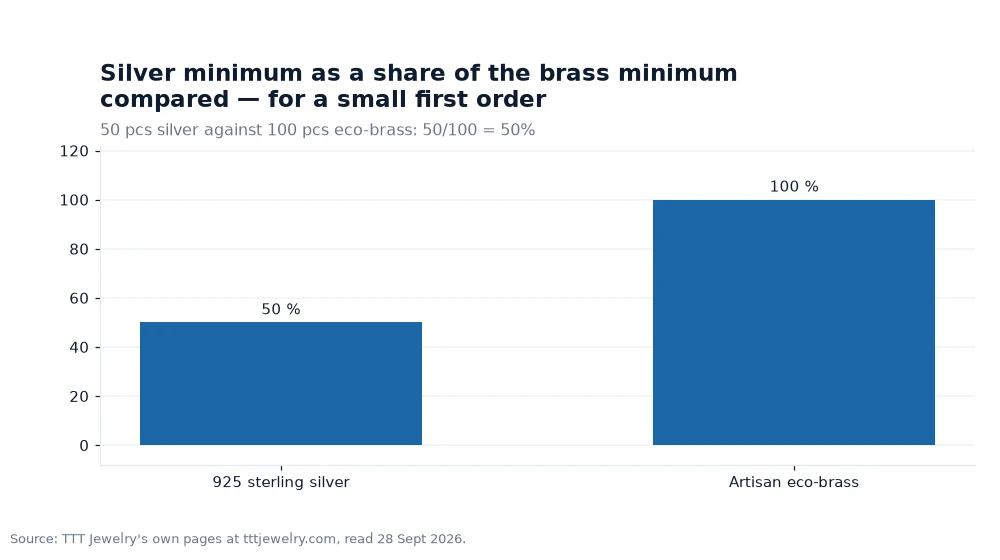
Set the brass minimum as the reference and express the silver minimum against it. Eco-brass is 100 pieces per design, which is the 100 mark; 925 sterling silver is 50 pieces per design. So silver is 50 ÷ 100 = 50% of the brass commitment on the same design.
Put in units rather than percentages: choosing silver for an untested design leaves 100 − 50 = 50 pieces of inventory unsold if the design fails, and those 50 pieces are the difference between a write-off you absorb and one that changes your next order.
The point is not that silver is better. It is that the minimum is the price of the risk, and the two can be chosen together — stainless steel at 100+ pieces sits above both and is the right call only when the wear pattern justifies it.
Frequently asked questions
Are designs really exclusive to the brand that commissioned them?
Yes, that is the published position: 100% NDA coverage, designs exclusive to the brand, and moulds or CAD files not resold or published for other buyers.
Should the NDA mention packaging and photography?
It should. Pouches, backing cards, barcode labels and sample photos all carry brand material, and they are usually the leak route rather than the tooling itself.
How do minimums reduce supplier risk?
They cap the units committed before a design has sold: 50 pieces per design in sterling silver at 925, artisan brass with recycled content and 316L stainless steel.
Putting the terms in place before tooling
The order to settle things in is: design terms first, then tooling, then materials. A brand that wants the confidentiality and IP terms on the table before a mould is cut will usually learn more from how the two routes handle ownership, since OEM keeps the drawing with the brand and ODM develops it on the brand's behalf.
After that, look at the audited production floor to see which stages are owned in-house, and check the wholesale and custom program for how ongoing orders are handled once a design is in production.
The specification this article works from — the plating list (14K, 18K and 24K gold plus rhodium), the 50, 100 and 100+ piece order minimums, followed by the master-sample benchmark — is published on the client's own website on the tttjewelry.com site, per a read on 28 Sept 2026. The unit conversions are my own arithmetic — the site supplies the inputs only[1].